AI engines now answer your customers’ questions
A growing share of purchase research happens inside AI assistants, not search engines. Someone asks Perplexity “best project management tool for remote teams” and gets a ranked list with explanations. They ask an AI assistant to compare two SaaS products and get a detailed analysis. They see Google’s AI Overview mention your competitor right in the search results.
Each AI engine forms its own opinion about your brand. ChatGPT might recommend you enthusiastically. Perplexity might not mention you at all. Google AI might cite your competitor’s case study instead of yours. Without monitoring, you don’t know which engines work for you and which work against you.
Brand monitoring makes this invisible layer visible. Every run queries all 8 engines with the same set of questions your potential customers ask — and shows you exactly what each engine says.
15 queries across 8 buying intents
Each monitoring run generates 15 queries: 10 non-branded and 5 branded. Non-branded queries mimic how real buyers search — they don’t mention your company name. These are the queries where AI decides whether to recommend you or your competitor.
The 10 non-branded queries cover 8 marketing angles: general recommendations (“best X in Berlin”), specific comparisons (“top X vs Y services”), budget segment (“affordable X”), enterprise solutions, niche specialization (“X for e-commerce”), quality and reviews (“highest rated X”), alternatives (“best X alternatives”), and use-case based (“best tools for improving online sales”). Each angle tests a different purchase scenario.
The 5 branded queries test what AI says when someone mentions your company directly: “[Brand] reviews,” “[Brand] vs competitors,” “[Brand] pricing.” This reveals AI’s opinion about your brand specifically — whether it endorses you, warns against you, or presents outdated information.
All 15 queries go to all 8 engines simultaneously. One monitoring run produces up to 120 AI responses to analyze.
8 AI engines, one dashboard
Each engine pulls from different sources, uses different models, and reaches different audiences. Monitoring all of them reveals the complete picture.
ChatGPT — 200M+ weekly users, real-time web search, the dominant AI assistant that heavily shapes purchase decisions. Perplexity — source-cited answers with clickable links in every response, the highest-quality traffic source from AI. Google AI (Gemini) — connected to Google’s search index and Knowledge Graph, bridging traditional SEO with AI visibility. You.com — multi-model AI search with real-time web access, providing sourced answers across multiple AI models.
Grok — integrated with X/Twitter, captures real-time social sentiment and trending discussions. AI Overviews — shown directly in Google Search results to billions of users, the single largest AI touchpoint by volume. Google AI Mode — experimental search feature combining Google’s index with conversational AI. Bing Copilot — embedded in Edge, Windows, and Office, reaching enterprise users through tools they already use.
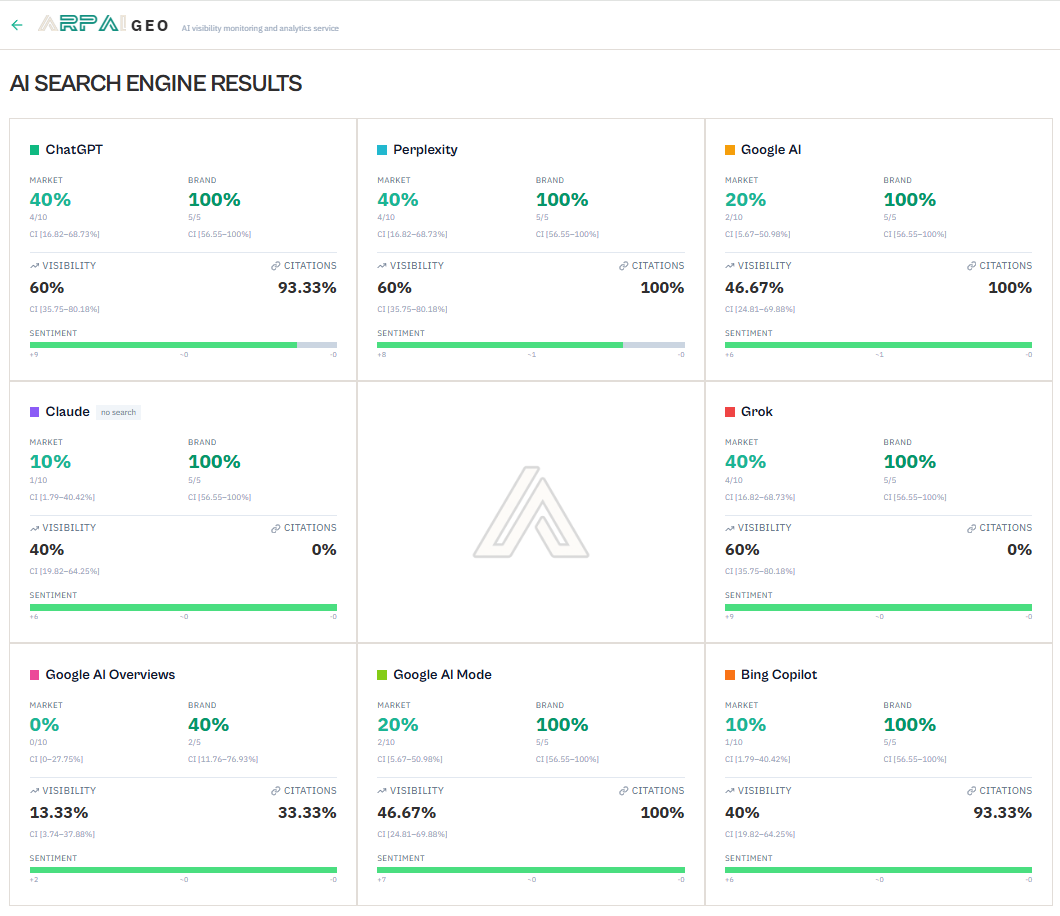
The dashboard displays each engine as a separate card with its own metrics. You instantly see where your brand is strong, where it’s absent, and where it’s mentioned negatively.
What metrics does brand monitoring track?
Each monitoring run distills all AI responses into five numbers. Together they form a complete diagnosis of your brand’s AI visibility.
Market SOV measures what percentage of non-branded AI responses recommend your brand vs competitors. This is your share of the “best X” conversation — when buyers ask for recommendations without naming anyone, how often does AI point to you?
Brand SOV measures the same for branded queries — when someone asks about you by name, how often does AI actually mention you? A low Brand SOV means AI doesn’t know enough about your company to respond accurately to direct queries.
Visibility is the percentage of AI responses that mention your brand at all, regardless of recommendation. High visibility with low SOV means AI knows about you but recommends competitors instead — a different problem from being invisible.
Citation Rate tracks how often AI includes a direct link to your website. Citations mean direct traffic. A brand can have high visibility but zero citations — AI talks about you but never sends visitors your way.
Sentiment shows whether AI describes your brand positively, neutrally, or negatively, scored from −1.0 to +1.0. A brand with 80% visibility but negative sentiment is worse off than one with 40% visibility and positive tone — AI is actively warning customers away.
Each metric includes Wilson confidence intervals, so you can distinguish real changes from statistical noise between monitoring runs.
Per-engine sentiment and position breakdown
Aggregate numbers hide engine-specific patterns. One engine might champion your brand while another actively undermines it — and the average looks acceptable. The per-engine view prevents this blind spot.
Each engine card displays its own Market SOV, Brand SOV, Visibility, and Citation Rate independently. Below these numbers, two visualization bars reveal what metrics alone miss:
The sentiment bar shows the ratio of positive, neutral, and negative mentions for that specific engine. ChatGPT might describe your product enthusiastically while Google AI presents it with reservations. Without per-engine sentiment, you’d never know one engine is undermining your reputation while another builds it.
The position bar shows where your brand appears in each engine’s ranked lists: top (mentioned first), middle, or bottom. Being mentioned is valuable. Being mentioned first is significantly more so — users act on the first recommendation. Position tracking reveals whether you’re the top pick or an afterthought.
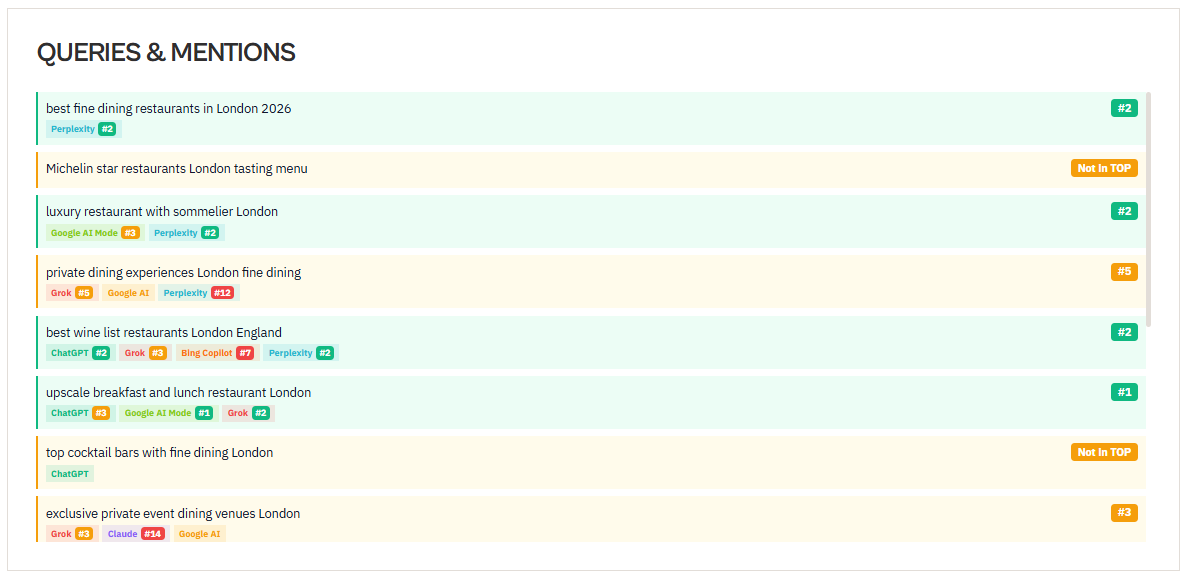
A query-engine map connects every metric to the specific question and engine that produced it. You can trace a low Market SOV directly to the two queries in Perplexity where your competitor appeared but you didn’t.
How does competitor tracking work?
Every monitoring run identifies which brands AI recommends alongside or instead of you. The competitor table ranks them by mention count with all five metrics per competitor. You see exactly who you’re losing to, in which engines, and by how much.
AI engines hallucinate brand names — they invent companies, merge two names into one, or recommend products from the wrong industry. Raw AI output is unreliable for competitive intelligence.
Every brand mention passes through a two-stage verification pipeline. First, an AI validation model cross-validates each mention: does this brand actually exist, does it operate in your industry, does it match the query context? Second, code-level bidirectional substring matching filters out partial matches and AI engine names that get misidentified as brands. Only verified mentions reach your dashboard.
A key changes banner highlights movements between monitoring runs: which competitor climbed, who dropped out, whether your position shifted, and by how many percentage points.
Recommendations and hypothesis testing
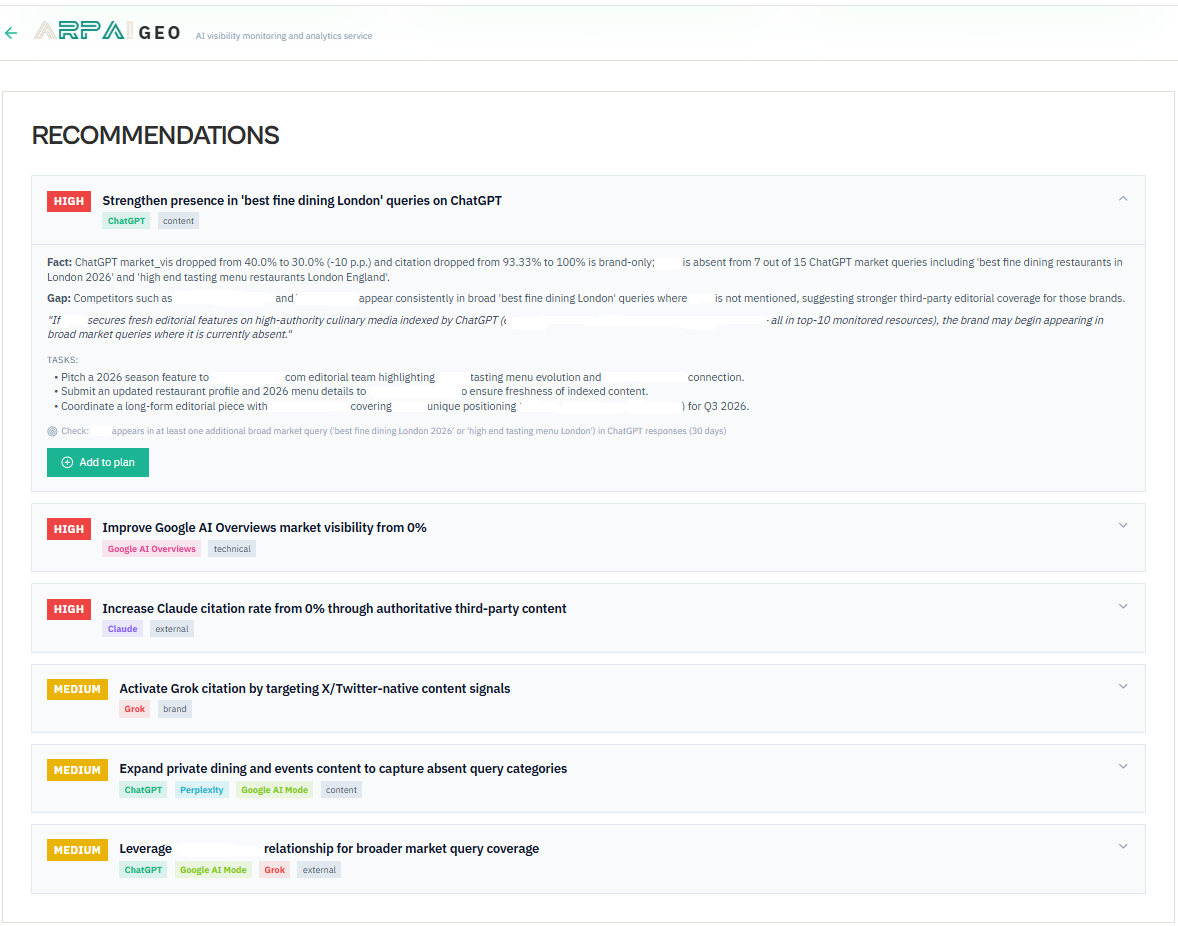
After each monitoring run, the system generates actionable recommendations based on your results, competitor landscape, and source citations. Not generic tips — actions tied to specific gaps in your data.
- Facts — what AI currently says about you, verified against actual engine responses
- Gaps — what AI doesn’t know about your brand that it should: missing product details, outdated pricing, absent case studies
- Hypotheses — testable predictions: “Publishing a comparison page should increase Market SOV by 10–15%”
- Concrete tasks — prioritized action items with expected impact and verification timelines
Convert any recommendation into a formal hypothesis. The system captures your current metrics as a baseline, records the expected change, tracks implementation tasks, and sets a verification date (default 21 days). After the next monitoring cycle, it compares before-and-after numbers and delivers a verdict: Confirmed, Refuted, Too Early, or Neutral.
Custom queries — ask AI exactly what you need
The 15 auto-generated queries cover standard buying scenarios. But your market has specific questions. A law firm needs to know what AI says about “best patent attorney for biotech startups in Munich.” A SaaS company wants to track “alternatives to [Competitor X] with API access.”
Custom queries let you add your own questions on top of the standard 15. Each custom query goes to all 8 engines alongside the regular set. Results appear in the same dashboard with the same metrics and the same hallucination filtering.
Each custom query costs $0.70 on top of the base $12 monitoring price. The formula: base cost + (number of custom queries × $0.70). Five custom queries bring a monitoring run to $15.50.
Multi-location monitoring and company profile
AI responses change by geography. “Best dental clinic” in Berlin produces different results than the same query in Munich. Each location is a separate monitoring point with its own metrics, competitors, and trends.
Add as many locations as needed — country, region, city. Each runs independently with geographic context injected into every query. A hotel chain can track visibility in Paris, London, and Barcelona simultaneously, discovering that it dominates in one city but is invisible in another.
The company profile feeds query generation with accurate context about your business. Auto-detection scrapes your website (checking robots.txt first) to extract company name, industry, products, and audience. You can edit everything manually: activities, products and services, target audience, USP, geography, brand aliases, and exclusion contexts. The more precise your profile, the more relevant the generated queries.
How do I set up brand monitoring?
- Enter your company URL. The system scrapes your website to auto-detect company name, industry, products, and target audience. Review and edit the auto-detected profile if needed.
- Add your first location — select country, region, and city. The system generates 15 queries tailored to your business and location. Review the queries, optionally add custom ones.
- Launch the monitoring run. Results appear within 3–5 minutes: five metrics, per-engine breakdown, competitor table, sentiment analysis, and actionable recommendations.
- Set up recurring monitoring to track changes over time, or run manually whenever you need a fresh snapshot.
Who uses brand monitoring?
SaaS companies track whether AI engines recommend their product or a competitor's when users ask "best project management tool" or "CRM for small business." One monitoring run reveals the gap — and which engines to focus on.
E-commerce brands monitor product-category queries across markets. A skincare brand selling in 12 countries can check AI visibility in each market and language simultaneously, spotting where competitors dominate and where there's an opening.
Local service businesses — law firms, dental clinics, agencies — use geo-targeted monitoring to see if AI recommends them when users ask "best dentist in Austin" or "marketing agency in Berlin." 72 countries and 44 languages mean every local market is covered.
Marketing agencies run monitoring for multiple clients, using the data to build GEO strategies backed by evidence rather than guesswork. Per-query rankings across 8 engines give clients a clear picture of where they stand.
Bottom Line
Brand monitoring gives you five metrics per AI engine per location: Share of Voice, Visibility Score, Citation Rate, Sentiment, and full competitor rankings. Run it once for a snapshot or set up recurring checks to track how your visibility changes over time. Each run queries 8 AI engines with 15 buying-intent questions — 120 data points per location.
See your brand through AI’s eyes
8 engines. 15 queries. 5 metrics. Full competitive intelligence. From $12 per run.
Start Monitoring →